APPLYING MULTI-DISCIPLINE COLLABORATION (ECAD/MCAD) TO REDUCE PROGRAM RISK
Rédaction Air & Cosmos
Ce contenu est réservé aux abonnés Air&Cosmos
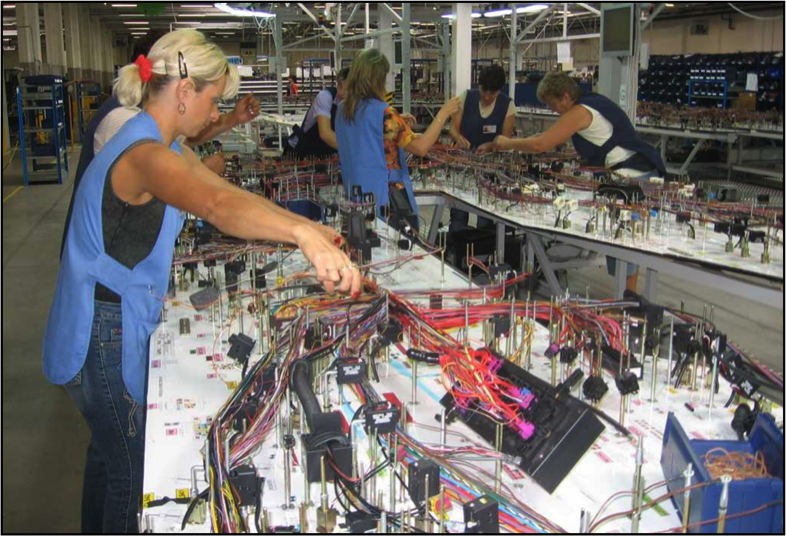
The formboard provides a full scale drawing of the harness to aid in manufacturing
Mentor, a Siemens Business.
APPLYING MULTI-DISCIPLINE COLLABORATION (ECAD/MCAD) TO REDUCE PROGRAM RISK
The design and manufacture of a new commercial aircraft is extremely complicated, expensive, and risky. The development can cost billions of dollars and last up to ten years before the new plane enters service. Increasing electro-mechanical complexity and density makes aircraft design especially challenging and resource intensive. Electronics govern a majority of the critical systems in next generation planes, like flight control actuation, cabin pressurization, and wing de-icing. The computers, sensors, and wiring needed to connect and control these systems will come to dominate the interior of the airframe. Cabin amenities add even more wiring due to increasing demands for entertainment and communication systems.
Aircraft must also support extensive redundancies to prevent individual system failures from causing catastrophe. The electrical wiring and interconnect systems (EWIS) regulations, set forth by the FAA, outline standards for the design, implementation and maintenance of airplane wiring harnesses. A major component of these regulations is the physical separation and segregation of electrical wires from other systems and from other wiring. This is crucial to achieving safety and redundancy requirements in a plane, and helps prevent failures such as harness chafing, arcing, and electromagnetic interference from damaging or disrupting other systems.
Despite its difficulty, electro-mechanical design and development must adhere to strict schedules. Delays in progress can cost the company millions of dollars in extra development and follow-on effects of late entry into service. What’s more, errors in design can snowball into larger problems when manufacturing begins, further jeopardizing progress. Even small inaccuracies in wire lengths or spacing between bundles can prevent the proper installation of the wire harnesses. This not only adds significant cost but also can delay delivery of aircraft to customers, affecting the company’s reputation and stock price.
WHY CO-DESIGN?
There is immense pressure on aircraft design teams to move quickly and hit program milestones. This can erode the motivation to perform extra analysis and validation of aircraft designs before release to initial production. Changes that are made without proper communication between the electrical and mechanical domains can inadvertently introduce EWIS violations into the design. If these go undetected until critical design review, the manufacturer will need weeks or even months to re-design, re-verify, re-release, and then retrofit each plane under construction. Such mistakes are incredibly costly and can put programs, careers, and even companies at risk.
Given the impact of ever-increasing electro-mechanical complexity, how do companies adjust their airplane development process in order to design accurately while meeting tight timelines? The optimal strategy is to use a process that allows for the incremental and digital exchange of ECAD and MCAD design data throughout the design process. Incremental data exchange ensures that the relevant multi-disciplinary features in the ECAD and MCAD platform representations are synchronized at each point in the design. This continual synchronization creates a steady line of communication between the electrical and mechanical engineers, increasing productivity and reducing design errors.
Newsletter
La Lettre Quotidienne
Entrez chaque jour au coeur des enjeux de l'aéronautique, de la défense et du spatial avec l'expertise de la rédaction et suivez les actualités structurantes de ces secteurs stratégiques.